


ChargEye – EV charging management software for developers
Build powerful experiences. Connect your EV chargers to ChargEye and ChargEye to your operations. Discover ChargEye REST API, standard interfaces, and developer tools.

Connect EV chargers via OCPP
ChargEye works with many OCPP 1.6j compliant EV chargers from different hardware manufacturers. This means you can fully leverage your existing investments and choose the most suitable hardware on the market in the future.
Want to bring your EV charger model to ChargEye?
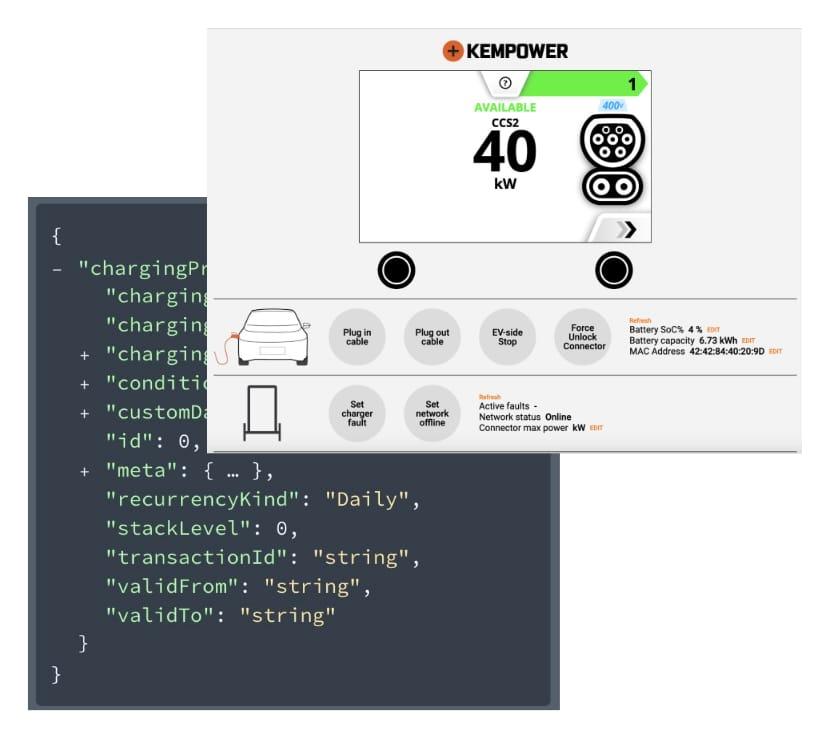
ChargEye is a developer-friendly platform
This is what makes ChargEye easier to integrate with existing systems: clear API documentation, standard interfaces, and virtual chargers that simulate EV charging and payment flows.
Available cloud interfaces
-

REST API
Provides access to individual data points and aggregates, enabling full control over EV chargers, transactions, and scheduling through a clean, modern interface. Here you can find the public REST-API-documentation. -

OCPI
Ideal for real-time notifications and status updates, providing dynamic information on charging events, status changes, and transactions. -

VDV463
Standard for communicating between EV charging management systems (CMS) and intermodal transport control systems (ITCS) and depot management systems.
-

OpenADR
Connects ChargEye to utilities and aggregators using a standard interface. -

Vehicle telematics
Bring vehicle state of charge and location into ChargEye from your own telematics feed via REST API, so vehicles appear alongside charging sites on a live map. Enabled by Kempower on request, on ChargEye Pro.
Our flexible APIs support complex scenarios, making it easy for developers to integrate and customize for a wide range of use cases from mobile apps to fleet management platforms.

Tailor-made solutions
Create customized solutions based on ChargEye data and commands, including:
- Real-time EV charger or connector status notifications via OCPI
- Remote commands to EV chargers and power control via REST API
- Real-time and historical EV charger and transaction data lookups via REST API
- Bring your own vehicle telematics into ChargEye via REST API.
You can create a rich, interactive dashboard to visualize your charging operations. Or with the power of data and scheduling, you can also efficiently manage and control large-scale EV charging operations.

Charging schedules
Use REST API or VDV463 interfaces to connect ChargEye smoothly to your operations. Bring schedules from your EV fleet management, transport management, depot management, or other planning systems to optimize fleet charging. Improve your planning with charging data from ChargEye.


Roaming
Connect your chargers to roaming hubs and EV charging service providers via the OCPI interface.

End user applications
Build intuitive mobile apps that display real-time charger availability and transaction information for end users. Focus on your loyalty and user experience features and let ChargEye to handle communication with chargers. Communicate with your app using ChargEye’s OCPI and REST API interfaces.
Kempower’s Virtual Charger supercharges your development team without hardware investments
Virtual Charger benefits
The Virtual Charger is designed to simplify and accelerate your integration projects, providing a reliable and efficient solution for testing and validation.
-

Cost-efficient
Reduce the need for expensive physical equipment during the development phase. -

Accessible anywhere
Get global access to the simulation environment through a web-based interface. -

Automated testing
Integrate with your CI/CD pipeline to ensure consistent quality by automating the testing of repeatable scenarios.

How it works
The Kempower Virtual Charger runs in a cloud-based environment, simulating all key components of a real charging system – from hardware to communication protocols. The EV simulator replicates CCS protocol behaviour, while the user interface allows you to monitor and control the charger as if it were a physical device.
Key Virtual Charger features
-
ChargEye integration
Validate integrations with Kempower’s ChargEye management system, including advanced settings and reporting. -
EV simulator
Simulate a CCS vehicle, allowing you to test various charging states, battery levels and fault conditions. -
Payment simulator
Simulate user interactions with a payment terminal to validate payment flow logic. -
REST API access
Automate your testing using the Virtual Charger’s REST API, perfect for continuous testing environments.


Call our sales team directly
Contact our sales team to learn more about which charging solution best fits your needs.
FAQ
ChargEye works with many OCPP 1.6j compliant EV chargers from different hardware manufacturers, so you can use existing investments and choose suitable hardware in future.
A REST API gives access to individual data points and aggregates, with full control over chargers, transactions and scheduling. OCPI is used for real-time notifications and status updates, VDV463 for communication between charging management systems and intermodal transport control or depot management systems, and OpenADR for connecting to utilities and aggregators.
The Virtual Charger runs in a cloud-based environment and simulates all key components of a real charging system, from hardware to communication protocols. An EV simulator replicates CCS protocol behaviour and a payment simulator validates payment flow logic, while the user interface lets you monitor and control the charger as though it were physical.
It reduces the need for expensive physical equipment during development, is accessible globally through a web-based interface, and can be integrated with your CI/CD pipeline to automate testing of repeatable scenarios. It also validates integrations with ChargEye, including advanced settings and reporting, and offers REST API access for continuous testing.
Yes. You can bring vehicle state of charge and location into ChargEye from your own telematics feed via the REST API, so vehicles appear alongside charging sites on a live map. This is enabled by Kempower on request, on ChargEye Pro.
Yes. You can connect chargers to roaming hubs and charging service providers via OCPI, connect infrastructure to utilities and aggregators via REST API and OpenADR, and build mobile apps showing real-time charger availability and transaction information using OCPI and REST API — letting your team focus on loyalty and user experience while ChargEye handles charger communication. Public REST API documentation is available at docs.kempower.io.